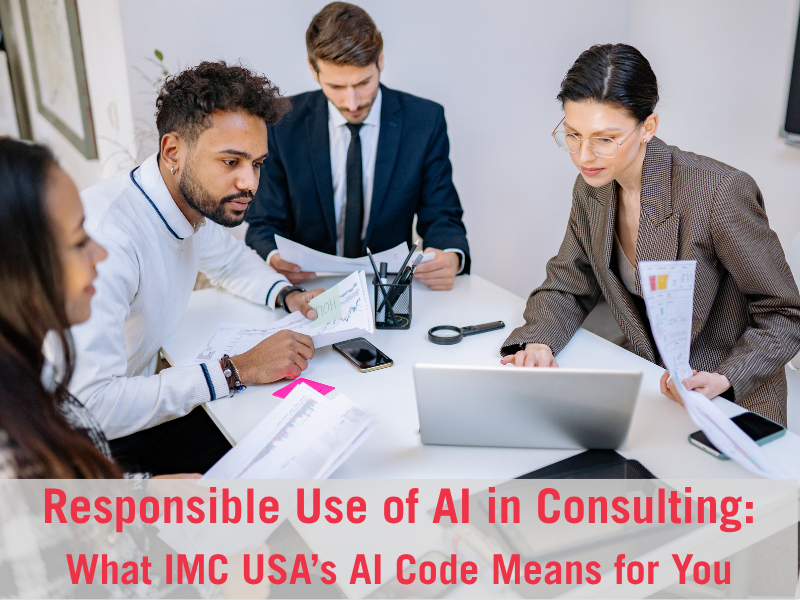
Imagine this: It’s Friday evening, and a client report is due Monday. Dana uses an AI tool to draft a market analysis. The result is clean, confident and well organized. She skims it, tightens a few sentences and sends it on. On Tuesday the client’s CFO asks where one of the statistics came from. Dana looks. The source doesn’t exist.
Nothing in this story required bad intent. It required only a busy week and a tool that sounds sure of itself. This is the situation the IMC USA Code of Responsible Use of AI was written for.
The Code applies to all IMC USA members and CMC®s. Everyone who joins IMC USA now agrees to its AI Code as part of the membership agreement. The Code itself was adopted by the International Council of Management Consulting Institutes (ICMCI) in May 2026, and it applies wherever AI “materially influences” the advice, analysis or deliverables a client receives. It runs to seven principles, and last month I wrote that IMC USA certifies how you work rather than what you know. This Code is that idea applied to AI. It says nothing about which tools you may use. It is about the conduct around them.
Here is what they mean in practice, grouped into three commitments to your clients and your profession.
Take Responsibility for AI-Assisted Consulting Work
Apply Human Judgment and Verify AI Outputs
Section 3.1 of the IMC USA AI Code says that AI can inform your advice, but it can’t make you any less responsible for it. The IMC USA AI Code expects meaningful human review and professional judgment before AI influences a client decision. It also expects you to be able to explain, in terms your audience understands, how an AI-assisted result was obtained. For higher-stakes uses, a qualified person must have the real ability to step in, override the system or shut it off.
Document Significant AI-Supported Decisions
Section 3.6 says that When AI supports a significant decision, write down what you used and why you relied on it. The Code puts the accountability on you as the individual consultant, not on the tool or the vendor.
Dana’s problem lives here. The Code lists “submitting unreviewed AI outputs as finished professional work” among its prohibited uses. The standard isn’t that you never use AI. It is that no AI output reaches a client until a competent human has checked it.
Be Transparent About AI and Protect Client Data
Disclose Material AI Use to Clients
3.3 of the IMC USA AI Code says when AI materially contributes to your analysis, recommendations or deliverables, tell the client. The Code says this should be proportionate: using a spell-checker doesn’t need disclosure, but AI-generated findings that shape a client’s decision do. You also shouldn’t present AI-generated content as purely your own original work when you haven’t reviewed and adapted it.
Protect Client Privacy and Confidentiality
3.4 of the IMC USA AI Code says don’t put confidential client data into any system that may reuse it, train on it or expose it. And if a client has told you how they want AI used or not used on their work, follow their instructions. For many of us this is the principle that will change daily habits first, because the convenient free tool is rarely the one with the right data terms.
Manage AI Risks and Consider Wider Impacts
Check for Bias and Discrimination
3.2 of the IMC USA AI Code tells consultants to take reasonable steps to keep AI from introducing or amplifying bias and check outputs for disparate impact on protected groups. Take particular care when the underlying data doesn’t represent the people affected.
Choose Secure, Reliable AI Tools
In 3.5 of the IMC USA AI Code we are guided to prefer tools with appropriate security and reliability, and have a way to catch, report and correct outputs that are wrong or harmful.
Consider AI’s Environmental, Social and Economic Impact
3.7 of the IMC USA AI Code tells consultants to consider the environmental, social and economic impact of the tools you choose, and use them in proportion to the need.
How IMC USA Enforces the AI Code
In September 2026, the IMC USA Board agreed to accept the Code and its consequences. That means the Code is not a statement of good intentions. The consequences it describes range from a formal warning or remedial training up to suspension or withdrawal of the CMC® designation, and suspension or expulsion from membership. I’d rather members come away with a working habit than a fear of penalties, so here is a practical test.
Three Questions to Ask Before Delivering AI-Assisted Consulting Work
- Have I verified the facts, calculations and sources—and can I explain how AI contributed to this work?
- Have I told my client when AI materially influenced the analysis, recommendations or deliverables?
- Have I confirmed that the tool’s data terms and safeguards protect any client information I entered?
If an answer makes you uneasy, that’s the Code doing its job. Each of those questions has a fix that takes less time than Dana’s Tuesday.
Share Your Experience with Responsible AI
I’d like to hear what’s working for you. Where has AI saved you time while maintaining the quality your clients expect? Share one example and the check you use to keep the work reliable. Please leave out client names and confidential details.
[Share your experience in the comments.]
Next month: who’s accountable when the AI gets it wrong, and why the answer is always the same.
Jeannette Hobson
Chair and CEO
IMC USA
This article received AI writing assistance
Fantastic article, Jeannette. This is very important for us as CMC®, as it clearly guides us on how to ethically use this powerful tools to work for us for the good of our clients.
I will immediately implement all its recommendations in my contracts and commercial material.